
Beyond the AI Prompt: Designing Digital VET Assessments That Truly Work
AI - “How can I help you today?”
Designer - “Please create a knowledge assessment with at least 20 multiple choice questions based on the knowledge evidence in the <source> unit of competency”

Registered Training Organisations (RTOs) are increasingly relying on AI-generated quizzes uploaded to a Learning Management System (LMS) – a quick AI prompt, a neatly generated quiz, and up it goes, job done. Except…it isn’t.
While AI-generated assessments can be comprehensive and substantively sound, simply uploading them to an LMS without thoughtful adaptation often results in poorly designed, generally non-compliant assessment tools.
The transition from paper-based to digital platforms requires deliberate design choices that go beyond simply ‘making marking easier’. You, as the designer, must consider how the assessment functions within the specific LMS environment, how learners will navigate and interact with it, and how the digital format affects accessibility and usability.
There are two layers to designing effective digital assessments: the foundational decisions that shape the learner experience, and the technical configuration that determines compliance.
Key Considerations
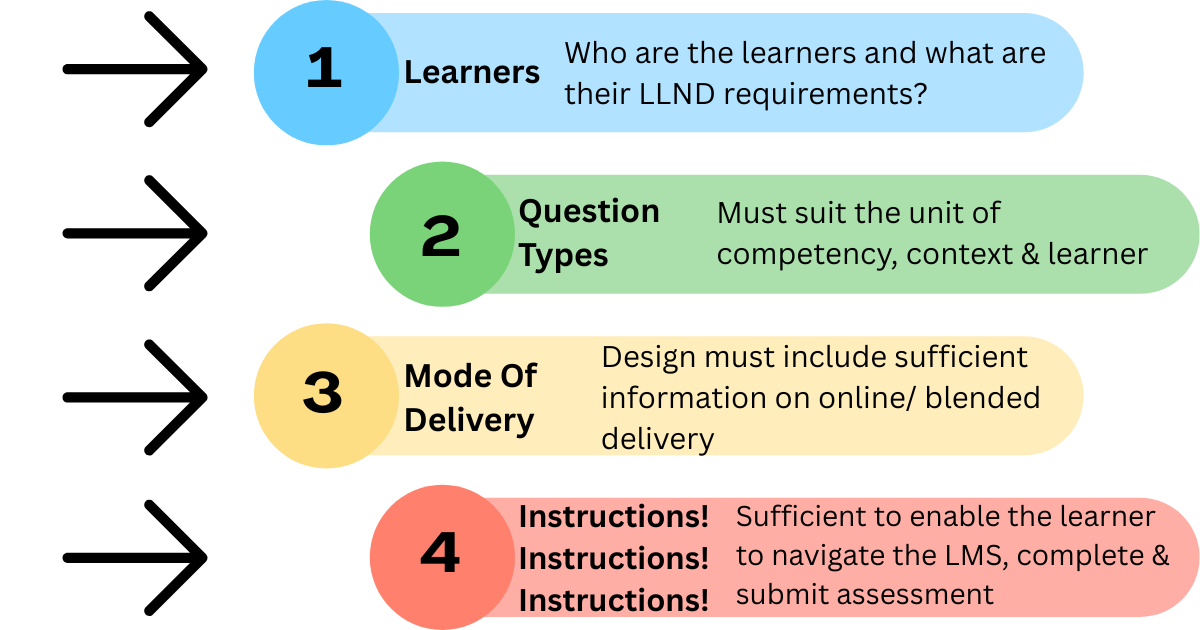
1. Understanding Your Learners
Think about who your learners actually are. Are they experienced workers returning to formalise their skills? School-aged learners navigating their first online assessment? The answers influence your assessment design decisions regarding interactivity, text placement, and the use of imagery, including how much fits on a single screen. You also need to factor in your learners’ Language, Literacy, Numeracy, and Digital Literacy proficiency (LLND), as these are essential to their success in understanding, completing, and submitting assessments.
2. Selecting Appropriate Question Types
Once you understand who your learners are, the next step is choosing question types that actually match what they need to demonstrate. Different question types serve different purposes and should keep learners engaged. Selection depends on the unit of competency requirements and what knowledge learners must demonstrate. For example, ordering questions test sequencing, while matching questions assess application. Short-answer or essay questions evaluate deeper understanding of complex concepts.
Rather than relying solely on multiple-choice questions, which can lead to disengagement, assessments should incorporate a variety of question types suited to the unit of competency requirements.
3. Delivery Mode
You must clearly communicate course delivery information regardless of whether the course is delivered entirely online or in a blended format. The introductory page should explicitly outline how the course is being delivered and how learners will access different components.
For example, if the LMS is used solely to host the assessment while the course instruction occurs in a face-to-face environment, learners need comprehensive introductory information that clarifies this delivery model. This ensures learners understand the complete course structure, not just the assessment requirements, and can navigate between face-to-face instruction and online assessment submission seamlessly.
4. Clear Instructions and Platform Navigation
Don’t underestimate the power of clear instructions. These should include step-by-step guidance on navigating the platform, understanding task requirements, and submitting work. Whether the course is delivered fully online or in a blended format, instructions must reflect the overall course delivery method and explain how the assessment integrates into the broader course design.
AI is certainly a good starting point for some of the initial heavy lifting when developing online assessments, but designing an assessment for a specific LMS requires more consideration.
Compliance Ramifications
Get the foundations right, and you’re well on your way. But there is one final, often overlooked, layer that can determine whether your digital assessment is truly compliant. That is the technical configuration of the questions themselves. Returning to those question types discussed earlier, their value in a digital environment depends entirely on how well they are configured.
However, transitioning these to a digital format requires mastering the mechanics of auto-marking. Unlike paper assessments, where a human assessor can interpret intent, LMS auto-marking is highly literal and relies on rigid, binary logic. You must carefully configure scoring parameters, such as enabling partial credit for multi-step tasks, to ensure learners aren't unfairly penalised for minor errors.
This configuration has compliance implications. If a digital assessment fails a competent student due to rigid auto-marking parameters or oversimplifies complex tasks just to fit a multiple-choice format, it directly violates the Principles of Assessment, such as Fairness and Validity.
To avoid this risk, you should program immediate, targeted automated feedback loops. Providing instantaneous remediation based on specific incorrect answers transforms a standard compliance check into a highly responsive, active-learning tool.
Final Note: AI can draft the questions. Only you can design the assessment.












Registered Training Organisations (RTOs) are increasingly relying on AI-generated quizzes uploaded to a Learning Management System (LMS) – a quick AI prompt, a neatly generated quiz, and up it goes, job done. Except…it isn’t.
While AI-generated assessments can be comprehensive and substantively sound, simply uploading them to an LMS without thoughtful adaptation often results in poorly designed, generally non-compliant assessment tools.