
Pre-Use Review of Assessment Tools
Every new (or updated) assessment tool your RTO uses must be reviewed before a single student ever saw it. Not validated — reviewed, prior to use. It is a distinct obligation, it sits under Outcome Standard 1.3, and it is one of the more commonly misunderstood requirements in the 2025 Standards.
The requirement is that you can demonstrate assessment tools are reviewed before use, to ensure the assessment tool meets the unit requirements, and that assessment can be conducted consistently with the Principles of Assessment and Rules of Evidence set out in Outcome Standard 1.4. Beyond compliance, though, the argument is simply practical: you want to know your tools work before you use them on real students.

What’s the difference between pre-use review and validation?
This is a common question. The two processes differ, and pre-use review could be considered a part of a full validation process.
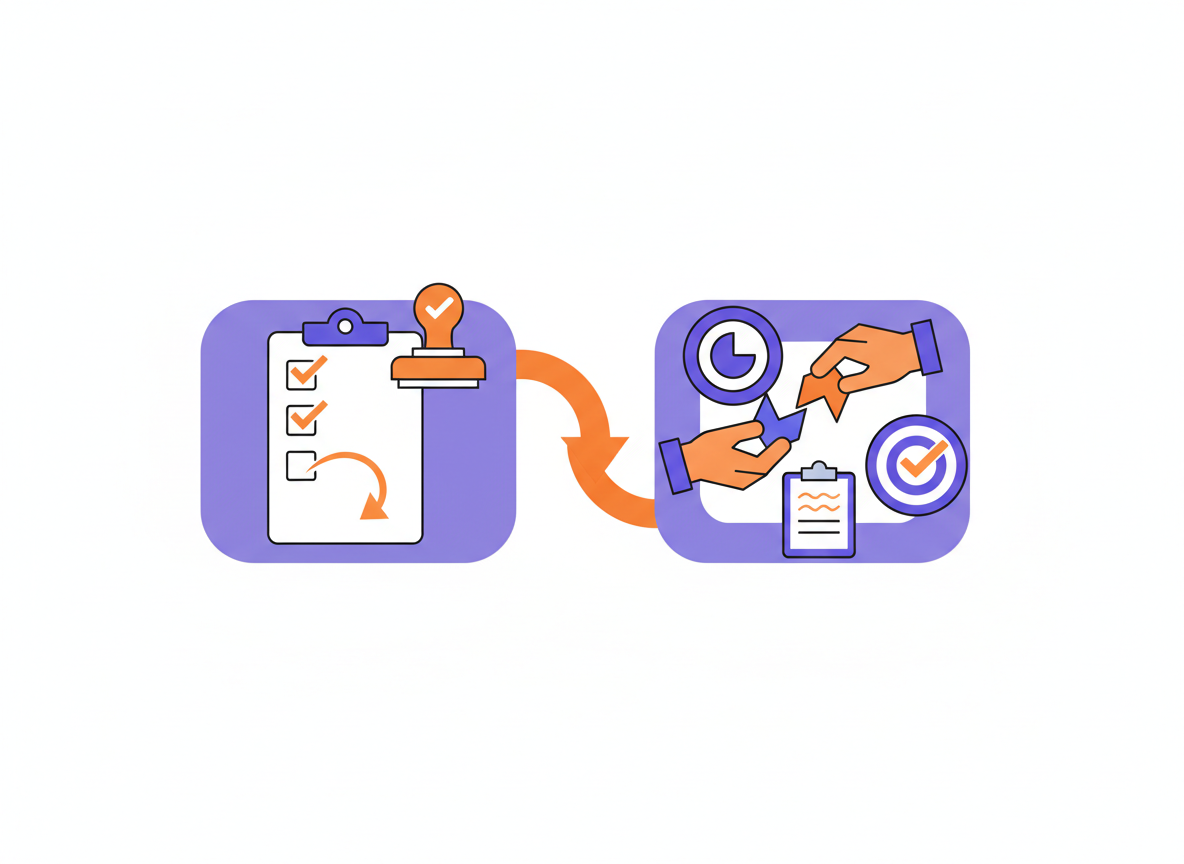
Pre-use review looks at the assessment tool only. It happens before first use. It asks whether the tool meets the requirements of the training product and whether it can be administered consistently with the Principles of Assessment and Rules of Evidence. The outcome is the final assessment tool that students will complete.
Validation looks at your whole assessment system — assessment tool plus applicable policies and procedures, training and assessment strategies and completed student work/assessor judgements. Because of the last two elements, the process of validation can only be completed after assessment. Validation outcomes might include an updated assessment tool but may be changes or improvements to other parts of the assessment system as a whole.
Put simply: validation considers an assessment tool and other parts of the assessment system that interact with it. Pre-use review is focused on the assessment tool only.
Who does it, and when?
Another important difference between validation and pre-use review is who can complete the review. The members of a validation team must meet certain requirements. Technically, anyone can conduct a pre-use review. There are no prescribed requirements. But in practice, pre-use review is going to involve people with similar skills, knowledge and experience (as a collective) as validation. Judging whether a tool meets unit requirements and will generate evidence meeting the Rules of Evidence realistically calls for someone holding a training and assessment qualification with relevant subject matter/industry expertise.
And just like validation, the reviewer should not be the person who developed the tool. Nobody signs off their own work.
On timing, pre-use review is required before the first use of a new tool, and again before reusing a tool you have changed. Importantly, the scale of the review can be proportionate to the change. Tweaked a couple of questions after a unit update? A quick check that those questions still meet what they are mapped to may be enough. Added a whole new task, changed the assessment method, or moved from a simulated environment to a real workplace? You may need a more thorough review thorough. Be sure to document the rationale for the type/nature of the review, in any records that are kept to prove the review occurred.
What are you actually checking?
A pre-use review must confirm two things about the assessment tool: one, that the requirements of the training product are met, and two, that the assessment tool can be administered in a way that meets the requirements of Outcome Standard 1.4 (the four Principles of Assessment and four Rules of Evidence).
On the training product, that means performance criteria, performance evidence, knowledge evidence — and also foundation skills and assessment conditions.
The Principles of Assessment ask whether the tool can be administered fairly (documented reasonable adjustment and reassessment processes), flexibly (methods and conditions that can adapt to student need), validly (knowledge assessed by having students tell you, skills by watching them do it or examining what they produced), and reliably (complete, clear benchmarks so the decision holds regardless of who assesses).
The Rules of Evidence ask whether the evidence generated will be valid, sufficient — including the volume and frequency the unit specifies, which is easy to miss — authentic, and current.
What records do you need to keep?
There is no prescribed requirement, so the test is simply: what shows the work you actually did? This can take any form, but your records should be able to tell an ASQA performance assessor the who, what, when and outcomes (including why any changes were made) of the review.
Do you need to review off-the-shelf tools?
If you buy tools off the shelf, the vendor’s assurance that they are mapped and audit-ready does not discharge your obligation. You must review them, and show you reviewed them, before use. The review can be proportionate to your confidence in the supplier, but it has to happen.
Want more information?
This article covers the basics of pre-use review. The full recording, Pre-Use Review of Assessment, presented by VETNexus compliance consultant Jack Murray, works through the detail — the complete pre-use review versus validation comparison, three practical review methods and when each suits, a full checklist of what to examine against the training product and against Outcome Standard 1.4, worked guidance on mapping depth, task-specific authenticity measures, the record-keeping formats that hold up under scrutiny, and a curated set of regulator and sector resources.
Purchase the recording, or unlock this session and our full library with the VETNexus PD Passport — unlimited access to every webinar, live and recorded, with certificates of attendance that count toward your professional development requirements.
Pre-use review of assessment tools is also one of our consulting services. If you would like us to review yours, get in touch for a quote based on the units you need covered.
For common questions, edge cases, and “what if…” scenarios, read the Pre‑Use Assessment Review FAQ:
https://www.vetnexus.com.au/blog/pre-use-assess-review-faq










Registered Training Organisations (RTOs) are increasingly relying on AI-generated quizzes uploaded to a Learning Management System (LMS) – a quick AI prompt, a neatly generated quiz, and up it goes, job done. Except…it isn’t.
While AI-generated assessments can be comprehensive and substantively sound, simply uploading them to an LMS without thoughtful adaptation often results in poorly designed, generally non-compliant assessment tools.